
ARCHAEOLOGICAL DISCOVERIES AT THE ROMAN SITE OF TIMACUM MINUS – RAVNA
Archaeological excavations at the Roman fort of Timacum Minus, located near Ravna, close to Knjaževac, continued in October 2026 as part of a joint project between the Institute of Archaeology in Belgrade and the Homeland Museum of Knjaževac. This year’s excavation campaign focused on the area south of the fort’s central building, originally used as the principia (military headquarters) and later transformed into a horreum (storage building).
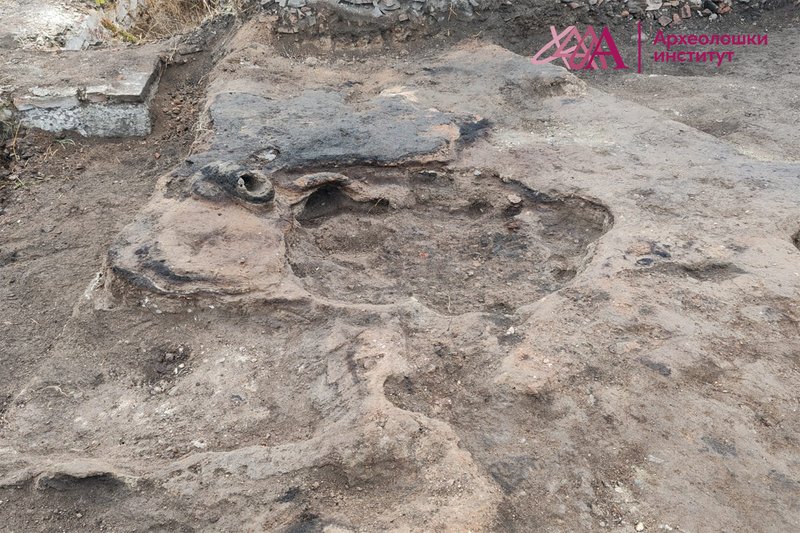
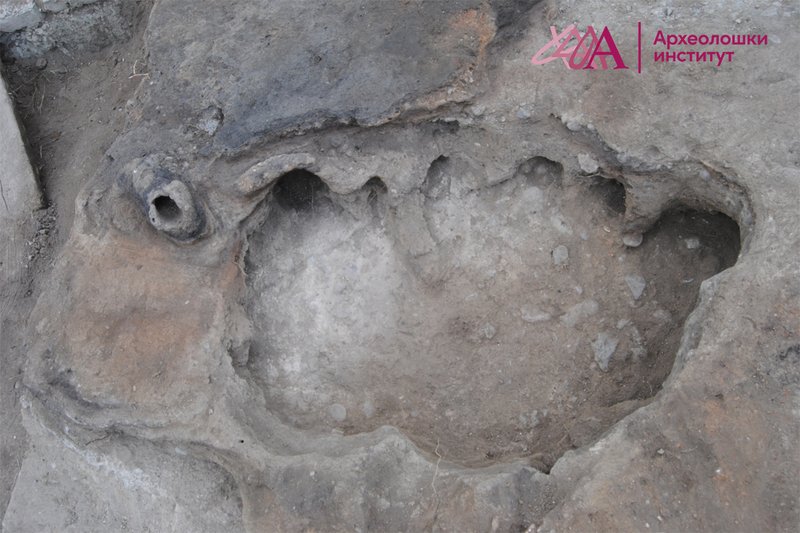
Among the most significant results was the discovery of the remains of a furnace, most likely used for metallurgical purposes, in the northeastern part of the excavated area. The furnace consisted of two chambers dug into the clay subsoil, with a partially preserved dome made of fired clay. Of particular importance was the discovery of a tubular element which, according to preliminary interpretations, was used to supply air through bellows. Large quantities of metallurgical slag, traces of intense burning, and finds of possible semi-finished iron products further confirm the importance of metallurgical activities at this site, which served as a major military and administrative centre of a mining district during the Roman period.
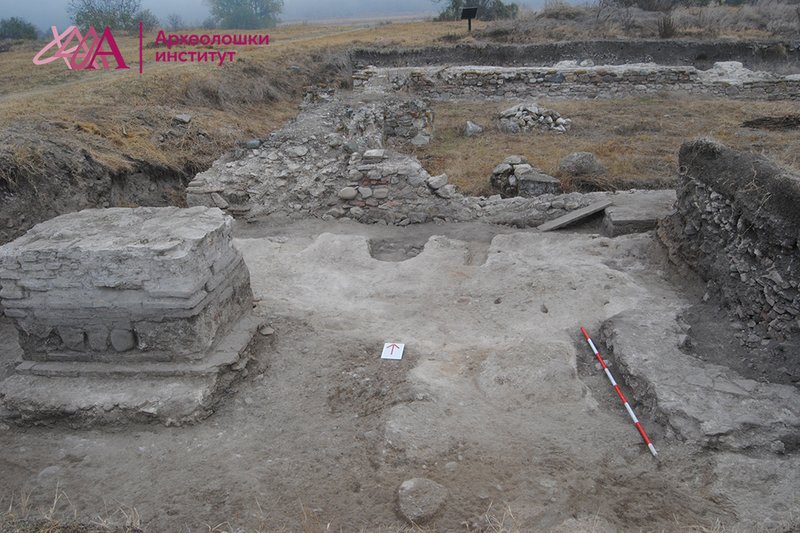
Another significant discovery was the remains of the original lime mortar floor in the portico, a covered walkway extending along the southern side of the horreum. The investigation of the floor and the foundations of the masonry pillars provided new insights into the architectural design and spatial organisation of this monumental building. Particularly important were the newly discovered remains of a wall constructed using the opus mixtum technique, which may belong to an earlier construction phase, associated with the original principia.
The results of this year’s excavations contribute to a better understanding of the architectural development and functional transformations of the central area of the fort during the Roman period. At the same time, they provide an important foundation for the planned conservation, restoration, and presentation of its architectural remains.
The project is directed by Dr Marija Jović, Research Associate at the Institute of Archaeology in Belgrade, while the field excavations were led by Bojana Ilijić, MA, archaeologist at the Homeland Museum of Knjaževac. The research team also included Dr Igor Bjelić, architect, and Nikola Radinović, MA, archaeologist.